
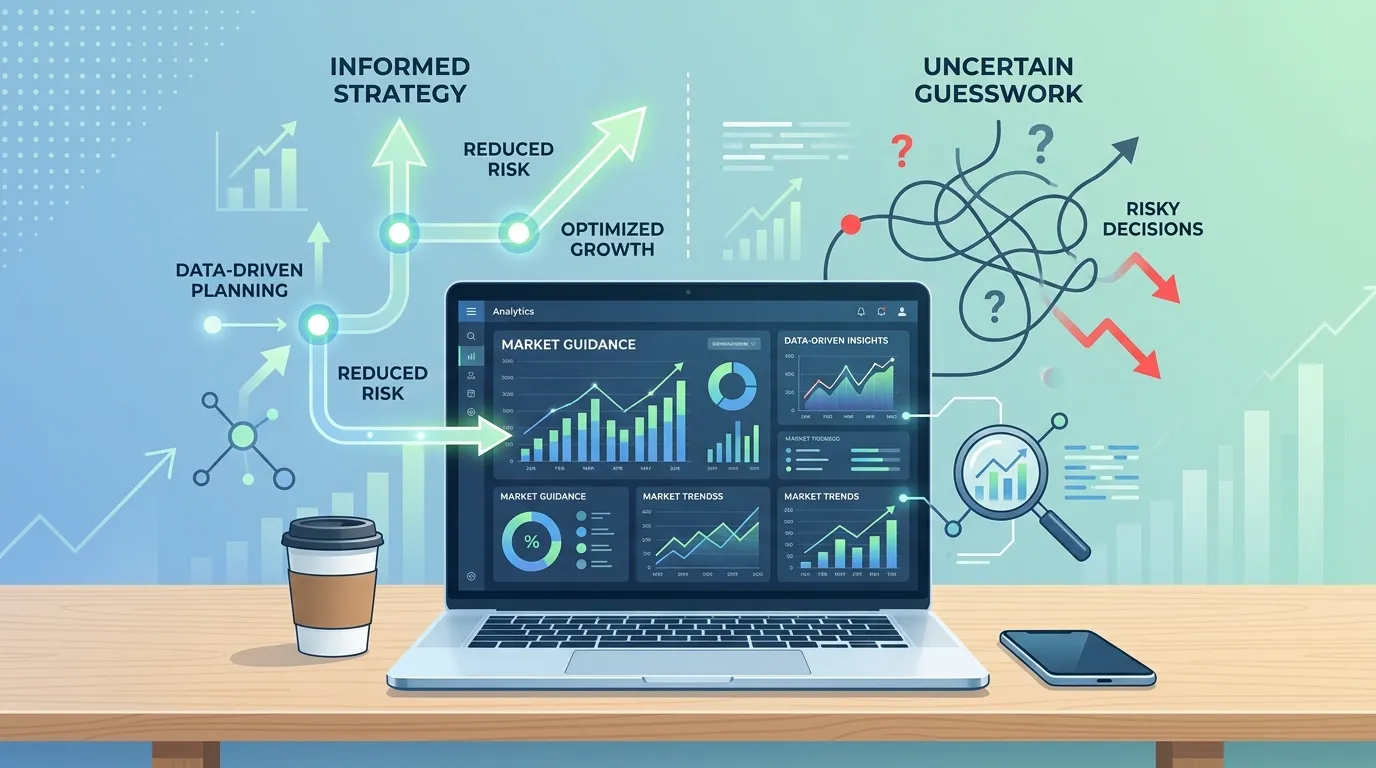
Market guidance matters because it helps businesses make smarter, data-driven decisions instead of relying on guesswork. By using research, analysis, and consumer insights, companies can reduce risk, identify new opportunities, and improve competitive positioning. When applied consistently, market guidance matters for driving sustainable growth, improving decision-making speed, and staying ahead in changing markets.
Market guidance is the practice of using data, research, and analysis to direct business decisions instead of relying on instinct alone. It matters because companies that ground their strategy in real market insights make faster, smarter moves—reducing risk, spotting opportunities early, and outpacing competitors who guess their way forward.
Every business decision is a bet. You’re wagering time, money, and resources on an outcome you can’t fully see. The question is whether you’re placing that bet with your eyes open or closed.
Market guidance is what opens your eyes. It’s the difference between launching a product because you “feel” the market wants it and launching because the data tells you it does. Companies that lean on solid market guidance don’t eliminate risk—no one can—but they shrink it dramatically. They know who their customers are, what competitors are doing, and where the next wave of growth is likely to come from.
This post breaks down what market guidance actually involves, why it deserves a permanent seat at your strategy table, and how to put it into practice. You’ll walk away with practical tips on market analysis, research techniques, consumer behavior, competitive positioning, and the financial fundamentals that tie it all together.
What is market guidance, and why does it matter?

Market guidance is the ongoing process of collecting, analyzing, and acting on information about your market. That includes your customers, competitors, industry trends, and the broader economic forces shaping demand. Think of it as a compass rather than a map. A map shows a fixed route, but a compass keeps pointing you in the right direction even when the terrain shifts.
Why does this matter so much? Because markets rarely sit still. Customer preferences change, new competitors appear, and economic conditions swing without warning. Businesses that operate on outdated assumptions tend to get blindsided. Those that treat market guidance as a habit—not a one-time project—stay nimble.
The payoff shows up in three concrete ways:
- Lower risk: When you understand the market, you avoid expensive missteps like launching a product nobody wants.
- Faster decisions: Clear data removes the endless back-and-forth that slows teams down.
- Stronger growth: Spotting trends early lets you move before the competition catches on.
What are the core market guidance strategies?
There’s no single formula, but the most effective approaches share common building blocks. The strongest strategies combine several of these elements rather than betting everything on one.
Set a clear market direction first
Before you collect a single data point, decide what you’re trying to learn. Are you exploring a new market? Defending your current position? Looking for an untapped customer segment? A vague goal produces vague insights. A sharp question—”Which age group is most likely to buy our premium tier?”—produces answers you can act on.
A few tips for setting business market direction:
- Tie every research effort to a specific decision you need to make.
- Write down your assumptions, then design research to test them.
- Set a timeline so analysis doesn’t drag on indefinitely.
Build a repeatable analysis cycle
One-off research goes stale fast. Build a rhythm instead—monthly, quarterly, or whatever suits your pace—so insights stay fresh and you can track changes over time. This cycle should feed directly into your planning meetings, not sit in a forgotten slide deck.
How do you conduct effective market analysis?

Market analysis is the engine room of good guidance. It turns raw information into insights you can use. The process usually moves through a few clear stages.
First, you gather data from multiple sources. Then you organize it so patterns become visible. Finally, you interpret what those patterns mean for your specific business. Skipping the interpretation step is a common mistake—data alone doesn’t make decisions, people do.
What market research techniques actually work?
Market research splits into two broad camps, and you’ll usually want both.
Primary research is information you collect yourself, tailored to your exact questions:
- Surveys: Quick and scalable for gathering opinions from many people at once.
- Interviews: Deeper one-on-one conversations that surface the “why” behind behavior.
- Focus groups: Small group discussions that reveal how people react to ideas in real time.
- Observation: Watching how customers actually behave, which often differs from what they say.
Secondary research uses existing information others have already gathered:
- Industry reports and white papers.
- Government and census data.
- Competitor financial filings and press releases.
- Trade publications and academic studies.
Primary research gives you specificity. Secondary research gives you context and scale, usually at lower cost. Choose primary research when you need answers no one else has; choose secondary research when reliable data already exists and you just need to find it.
How do you analyze consumer behavior?
Understanding what customers do—and why—is the heart of market guidance. Consumer behavior analysis looks at the full journey: how people discover a product, what pushes them to buy, and what makes them come back or walk away.
Pay attention to a few key signals:
- Purchase patterns: What people buy, how often, and in what combinations.
- Decision triggers: The events or emotions that prompt a purchase.
- Pain points: The frustrations that stop people from buying or cause them to leave.
- Loyalty drivers: What keeps customers returning instead of switching.
The goal isn’t to label customers—it’s to predict them. When you understand the patterns behind behavior, you can design products, pricing, and messaging that meet people where they already are.
How do you position against competitors?
Competitive market positioning is about claiming a clear, defensible spot in your customer’s mind. It answers a simple question: why should someone choose you over the alternatives?
Start by mapping your competitors honestly. Identify who they are, what they offer, and where they’re strong or weak. Then find the gap—the need they’re not meeting well. That gap is your opening.
Strong positioning rests on three pillars:
- Differentiation: Something meaningful that sets you apart, whether it’s price, quality, speed, or service.
- Relevance: That difference has to matter to the customer. Being different in a way nobody cares about is just noise.
- Credibility: You need to deliver on the promise, or the positioning collapses.
Revisit your positioning regularly. Competitors shift, and a spot that felt unique last year may be crowded today.
What are the basics of financial market guidance?
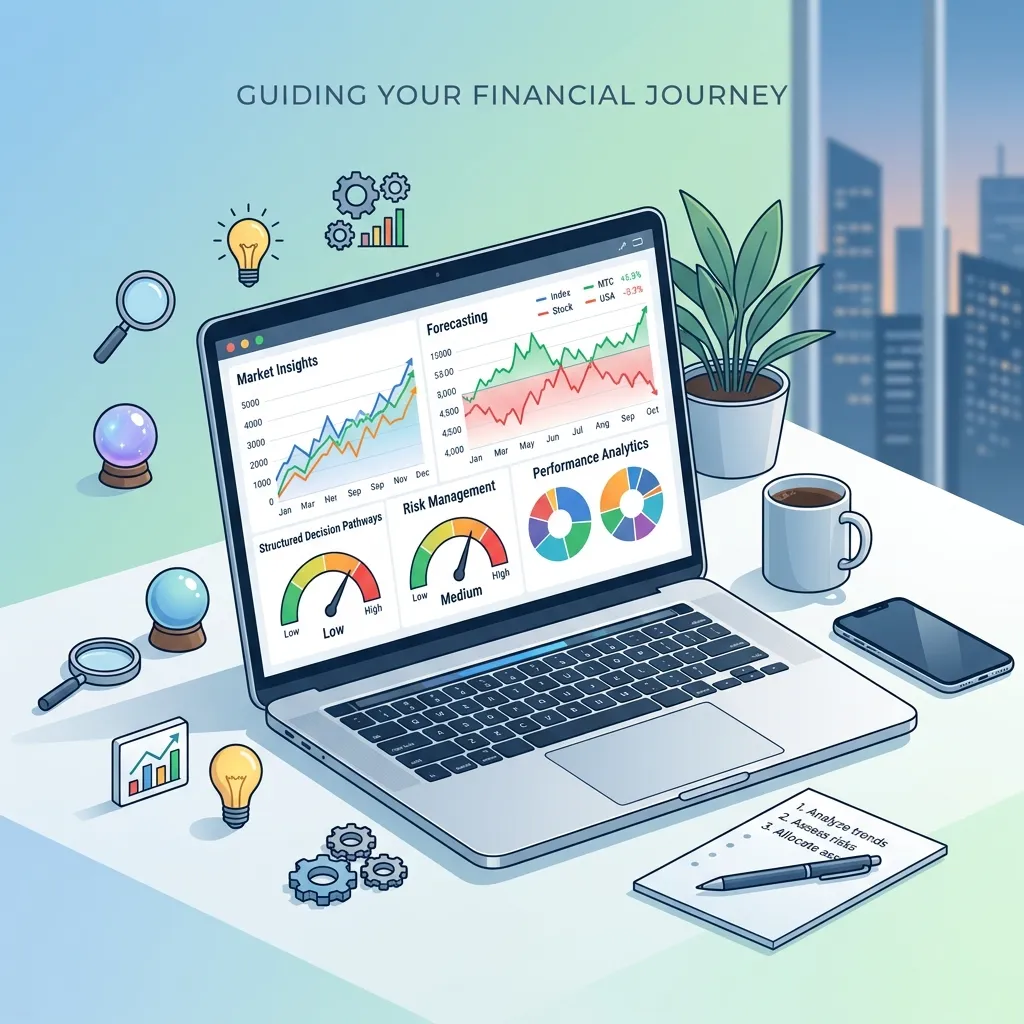
Market guidance and financial discipline go hand in hand. You can have brilliant insights, but if the numbers don’t work, the strategy won’t survive.
A few financial fundamentals anchor every sound market decision:
- Demand forecasting: Estimating how much customers will buy so you can plan inventory, staffing, and cash flow.
- Pricing analysis: Understanding what customers will pay and how price changes affect demand.
- Cost awareness: Knowing your margins so you can tell which opportunities are actually profitable.
- ROI tracking: Measuring whether your market investments—campaigns, launches, expansions—pay off.
The point of financial guidance isn’t to kill ambitious ideas. It’s to make sure the ideas you chase have a realistic path to paying for themselves.
How does market guidance fuel business growth?

Growth rarely happens by accident. The businesses that scale tend to be the ones that turn market insights into deliberate action. Here’s how strong market guidance translates into growth strategies.
Find new segments. Your research may reveal customer groups you’ve overlooked. Serving them can open fresh revenue without reinventing your product.
Refine your offering. Consumer behavior analysis often points to features people want or friction they’d pay to remove. Acting on this keeps your product relevant.
Time your moves. Spotting trends early lets you enter a market while it’s still rising rather than crowded.
Expand thoughtfully. Whether it’s a new region or a new product line, market guidance tells you where demand actually exists—so expansion is a calculated step, not a leap of faith.
The thread connecting all of these is patience paired with evidence. Growth built on guesswork tends to wobble. Growth built on market guidance tends to hold.
Turning insight into action
Market guidance isn’t a luxury reserved for big corporations with research departments. It’s a discipline any business can adopt, starting small and building from there. The core idea stays the same whether you’re a solo founder or a large team: decisions grounded in real market understanding beat decisions based on hope.
Start with one question that matters to your business right now. Gather the data you can, analyze it honestly, and let it shape your next move. Then build the habit. Over time, market guidance stops being a task and becomes the way you think.
Your next big bet is coming. Market guidance is how you place it with your eyes wide open.
Frequently asked questions
What is the difference between market guidance and market research?
Market research is the activity of gathering information about a market. Market guidance is the broader practice of using that research—plus analysis and judgment—to direct business decisions. Research feeds guidance, but guidance is what turns data into action.
How often should a business update its market analysis?
It depends on how fast your market moves, but a quarterly review works well for most businesses. Fast-changing industries like technology or fashion may need monthly check-ins, while more stable markets can review less frequently. The key is consistency, not a fixed calendar.
How much does market guidance cost?
Costs vary widely. Secondary research using public reports and government data can be nearly free. Primary research like surveys and focus groups costs more, depending on scale. Many small businesses start with low-cost methods and invest more as they grow and the stakes rise.
Can small businesses do market guidance without a big budget?
Yes. Small businesses can start with free secondary sources, simple customer surveys, and direct conversations with their audience. The principles are the same at any size—what changes is the scale, not the value of the insight.
What’s the biggest mistake businesses make with market guidance?
The most common mistake is treating it as a one-time project rather than an ongoing habit. Markets change constantly, so insights from a single study age quickly. Businesses that build a regular rhythm of analysis stay far ahead of those that research once and forget.
What is market guidance?
Market guidance is the process of using data, research, and analysis to guide business decisions and strategies.
Why does market guidance matter?
Market guidance matters because it reduces guesswork and helps businesses make more accurate and profitable decisions.
How is market guidance different from market research?
Market research collects data, while market guidance uses that data to shape real business decisions and strategies.
What are the main benefits of market guidance?
It improves decision-making, reduces risk, increases efficiency, and helps identify growth opportunities early.
Who should use market guidance?
Any business—from startups to large enterprises—can benefit from using market guidance for better strategic planning.
What tools are used in market guidance?
Businesses use surveys, analytics platforms, CRM tools, industry reports, and consumer behavior tracking systems.
How often should market guidance be updated?
It should be reviewed regularly, typically quarterly, to keep up with changing market trends and customer behavior.
Can small businesses use market guidance effectively?
Yes, even small businesses can use simple surveys, customer feedback, and free data sources to apply market guidance.
What role does consumer behavior play in market guidance?
Consumer behavior helps businesses understand buying patterns, preferences, and decision triggers for better targeting.
How does market guidance support business growth?
It helps businesses spot opportunities early, improve products, and make strategic moves that lead to sustainable growth.