

Client support services help businesses deliver fast, reliable, and personalized assistance across the entire customer journey. By combining help desk tools, CRM systems, omnichannel support, and AI, businesses can improve customer satisfaction, increase retention, and build long-term loyalty.
Client support services encompass the full range of solutions businesses use to assist, retain, and satisfy customers—from help desk and technical support to omnichannel communication and CRM. Investing in the right support infrastructure directly improves customer retention, brand loyalty, and revenue.
Every business loses customers. Some lose them because of price. Others lose them because of product issues. But research from Microsoft consistently shows that poor customer service is the leading reason consumers switch brands. Not pricing. Not competition. Service.
That’s what makes client support services so strategically important. Done well, they transform one-time buyers into loyal advocates. Done poorly, they quietly erode your revenue base—often before you notice the pattern.
This guide covers everything you need to know about modern client support services: what they include, why they matter, and how to build or outsource a support infrastructure that drives real business outcomes. Whether your current system is a single help desk inbox or a complex omnichannel operation, you’ll find actionable insights to elevate it.
What Are Client Support Services?

Client support services refer to the systems, teams, and technologies businesses deploy to assist customers before, during, and after a purchase. The goal is straightforward: resolve issues quickly, communicate clearly, and ensure every customer interaction reinforces trust in your brand.
The scope of client support has expanded dramatically over the past decade. Customers now expect support across multiple channels—email, phone, live chat, social media, and self-service portals—often simultaneously. They expect fast responses, personalized interactions, and seamless handoffs between departments.
A robust client support strategy touches several core functions:
- Customer service solutions — Proactive and reactive support for general customer inquiries
- Help desk support services — Ticketing systems and first-line issue resolution
- Technical support services — Specialized assistance for product or software issues
- Omnichannel customer support — Unified support delivered across all communication channels
- Client relationship management (CRM) — Tools and processes for managing customer data and interactions
- Customer experience management — End-to-end oversight of the customer journey
Each of these functions plays a distinct role—but they work best when they’re integrated into a coherent system.
Why Client Support Services Are a Business-Critical Investment
Many companies still treat customer support as a cost center: a necessary overhead with no direct revenue impact. This framing is both outdated and expensive.
According to Bain & Company, increasing customer retention rates by just 5% can increase profits by 25% to 95%. The mechanism is simple. Retained customers spend more, refer others, and cost less to maintain than new acquisitions. Strong client support services are one of the most reliable drivers of retention.
There’s also a reputational dimension. A single unresolved complaint, if shared publicly, can reach thousands of potential customers. Conversely, a support interaction handled exceptionally well often generates positive word-of-mouth that no marketing budget can replicate.
What happens when client support services fail?
The consequences of poor support are measurable and immediate. Customer churn accelerates. Support ticket backlogs grow. Teams burn out. And leadership scrambles to diagnose a problem that was preventable.
Common failure points include:
- Long response and resolution times
- Inconsistent information across channels
- Poor integration between help desk tools and CRM platforms
- Undertrained or understaffed support teams
- No self-service options for common queries
Identifying these gaps early—and addressing them systematically—is what separates reactive support operations from genuinely effective ones.
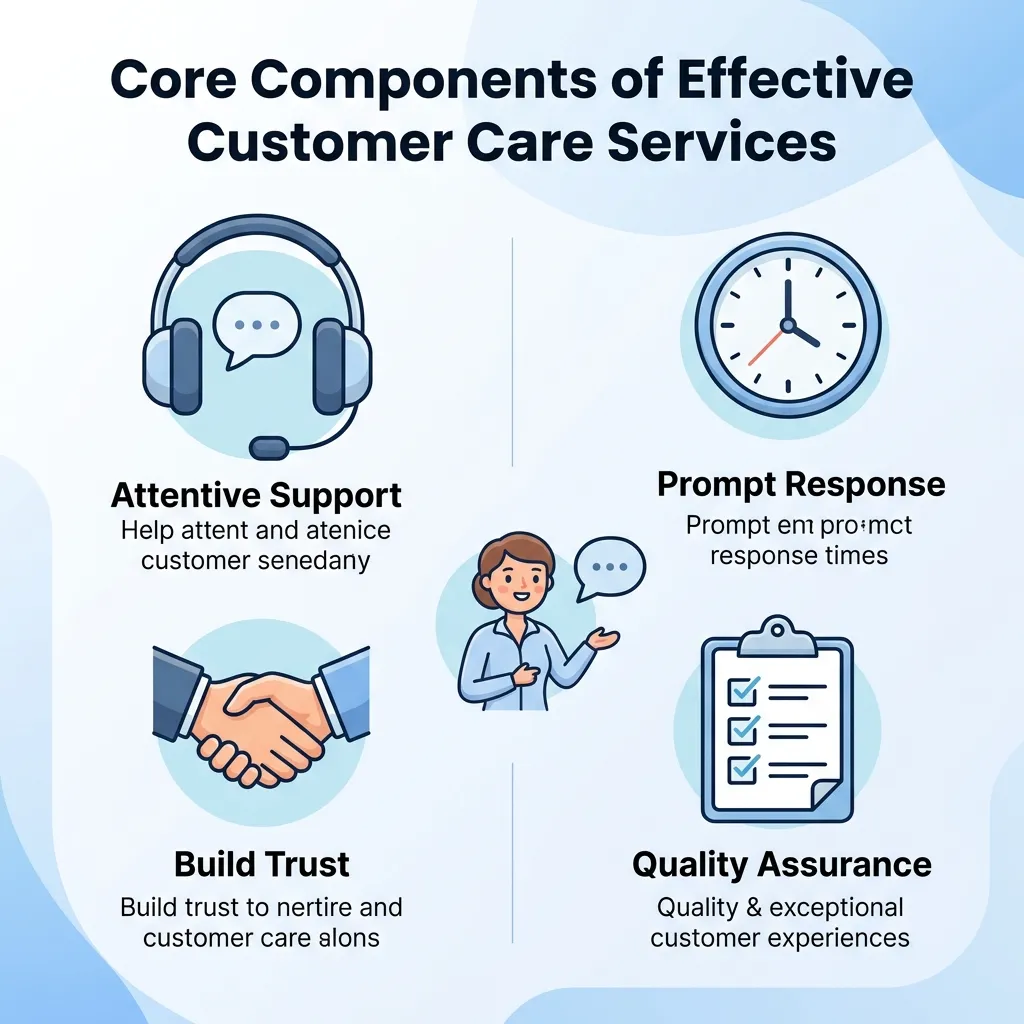
Core Components of Effective Customer Care Services
Help desk support services: the foundation of any support operation
A help desk is the operational backbone of client support. It’s where incoming requests are logged, categorized, prioritized, and routed to the right team member. Modern help desk platforms—such as Zendesk, Freshdesk, and HubSpot Service Hub—automate much of this workflow, reducing manual effort and improving resolution speed.
Key metrics to track within your help desk include:
- First response time (FRT): How quickly a customer receives an initial reply
- First contact resolution (FCR): The percentage of issues resolved in a single interaction
- Average handle time (AHT): The average duration of a support interaction
- Customer satisfaction score (CSAT): Post-interaction feedback from customers
Benchmarks vary by industry, but a first response time under one hour for email and under one minute for live chat is generally considered best practice.
Technical support services: resolving complex issues at scale
Technical support is a specialized branch of client support focused on product- or technology-related problems. It typically operates in tiers:
- Tier 1: Basic troubleshooting and FAQs, often handled by front-line agents or automated systems
- Tier 2: Intermediate issues requiring deeper product knowledge
- Tier 3: Complex, escalated problems requiring engineering or specialist involvement
For SaaS companies, e-commerce platforms, and tech hardware brands, technical support services are often the most critical touchpoint in the customer journey. A customer who gets stuck and can’t get help will churn—regardless of how good the product is.
Omnichannel customer support: meeting customers where they are
Omnichannel support means delivering consistent, connected service across every communication channel a customer uses. This is distinct from multichannel support, which simply means being present on multiple channels. Omnichannel goes further: the customer experience remains seamless even when switching from chat to email to phone.
In practice, this requires:
- A unified customer profile that captures interaction history across channels
- Integrated tools that allow agents to see the full context of a customer’s journey
- Consistent messaging and tone regardless of channel
According to Aberdeen Group, companies with strong omnichannel customer engagement retain an average of 89% of their customers, compared to 33% for companies with weak omnichannel strategies.
Client relationship management (CRM): the data layer beneath great support
A CRM platform is the data infrastructure that makes personalized, proactive support possible. By centralizing customer information—purchase history, past interactions, preferences, and lifecycle stage—CRM tools give support agents the context they need to resolve issues faster and communicate more effectively.
Leading CRM platforms used in client support include Salesforce, HubSpot, and Zoho CRM. When integrated with a help desk, these tools create a powerful feedback loop: support interactions inform customer profiles, and customer profiles enable more targeted, personalized service.
Outsourced Client Support: When Does It Make Sense?

Many businesses—particularly growing SMBs and startups—reach a point where building an in-house support team becomes cost-prohibitive. Outsourced client support offers a scalable alternative, providing access to trained agents, established workflows, and 24/7 coverage without the overhead of a full in-house team.
What are the benefits of outsourcing customer support?
- Cost efficiency: Outsourcing typically reduces support costs by 40–60% compared to in-house teams, according to Deloitte
- Scalability: Easily scale capacity up or down based on seasonal demand or business growth
- 24/7 availability: Global outsourcing partners enable around-the-clock coverage across time zones
- Specialized expertise: Outsourced providers often bring industry-specific knowledge and established quality assurance processes
What are the risks of outsourcing client support?
The risks are real—and worth planning for. Loss of brand voice, inconsistent quality, and data security concerns are the most commonly cited challenges. These can be mitigated through rigorous vendor selection, detailed service-level agreements (SLAs), comprehensive training materials, and regular performance audits.
Outsourcing works best when the vendor is treated as a strategic partner, not simply a low-cost labor alternative.
Customer Experience Management: Supporting the Full Journey
Customer experience management (CEM) takes a broader view than traditional support. Rather than focusing on individual interactions, CEM looks at the entire customer lifecycle—from first awareness through purchase, onboarding, support, and renewal.
Effective CEM requires cross-functional collaboration between marketing, sales, product, and support teams. It uses tools like Net Promoter Score (NPS), customer effort score (CES), and journey mapping to identify friction points and continuously improve the overall experience.
For businesses operating at scale, investing in CEM is one of the highest-leverage activities available. It shifts the focus from fixing problems reactively to designing an experience that prevents them from occurring in the first place.
How to Build a Client Support Strategy That Scales
Building a scalable support operation requires more than hiring good people and deploying the right tools. It requires a deliberate strategy aligned with your business goals and customer expectations.
Start with your customer: Map the most common support scenarios your customers encounter. What questions do they ask most frequently? Where do they get stuck? Which issues escalate most often? This analysis should drive both your staffing model and your knowledge base.
Invest in self-service: Gartner predicts that by 2027, chatbots and self-service tools will become the primary customer service channel for roughly 25% of organizations. A well-maintained knowledge base, FAQ section, and AI-powered chat function can deflect a significant volume of routine tickets—freeing your agents to handle complex, high-value interactions.
Define your SLAs: Service-level agreements set expectations internally and externally. Define response and resolution time targets by ticket priority, and build reporting systems that track performance against those targets consistently.
Hire and train strategically: The quality of your support team is ultimately determined by how well you hire and how thoroughly you train. Invest in onboarding, ongoing coaching, and product education. Agents who understand what they’re supporting deliver faster, more accurate resolutions.
Use data to drive improvement: Every support interaction generates data. Review it regularly. Track CSAT trends, monitor FCR rates, and analyze ticket categories to identify recurring product or process issues. The most valuable insight from your support operation often isn’t about support at all—it’s about your product.
The Future of Client Support Services
Artificial intelligence is reshaping client support faster than most organizations anticipated. AI-powered chatbots now handle a growing proportion of Tier 1 inquiries. Sentiment analysis tools flag at-risk customers in real time. Predictive support models identify likely issues before customers even report them.
But the fundamentally human elements of great support—empathy, judgment, creative problem-solving—remain irreplaceable. The most effective client support operations in the coming years will be those that combine AI efficiency with genuine human connection: using technology to handle volume, and freeing their best people to handle complexity.
Building Support That Customers Actually Remember
Client support services are not a commodity function. They are one of the clearest expressions of what your business values—and one of the most powerful levers you have for building long-term customer loyalty.
The path forward is clear: integrate your tools, train your people, embrace the right technology, and keep the customer at the center of every decision. Businesses that treat support as a strategic investment—not a necessary expense—will consistently outperform those that don’t.
Start by auditing your current support operation against the frameworks in this guide. Identify your biggest gaps. Prioritize the changes with the highest impact on customer satisfaction and resolution speed. Then build from there.
Frequently Asked Questions
What are client support services?
Client support services help businesses assist customers before, during, and after a purchase through multiple communication channels.
What is the difference between customer service and client support services?
Customer service focuses on individual interactions, while client support services cover the entire customer support process and lifecycle.
Which metrics measure client support performance?
Key metrics include First Response Time (FRT), First Contact Resolution (FCR), Customer Satisfaction (CSAT), Net Promoter Score (NPS), and Average Handle Time (AHT).
When should a business outsource client support?
Businesses should consider outsourcing when support volume grows, 24/7 coverage is needed, or specialized expertise is required.
What is omnichannel customer support?
It provides consistent customer support across channels like phone, email, live chat, social media, and self-service.
How does CRM software improve client support?
CRM software centralizes customer data, helping support teams deliver faster and more personalized assistance.
How does AI improve client support services?
AI automates routine tasks, routes inquiries, powers chatbots, and helps agents resolve issues more efficiently.
What features should client support software include?
Essential features include ticket management, live chat, automation, CRM integration, reporting, and knowledge bases.
Why are client support services important for businesses?
They improve customer satisfaction, increase retention, strengthen loyalty, and enhance the overall customer experience.
Can small businesses benefit from client support services?
Yes. Even small businesses can improve efficiency and customer satisfaction by using scalable support tools and automation.